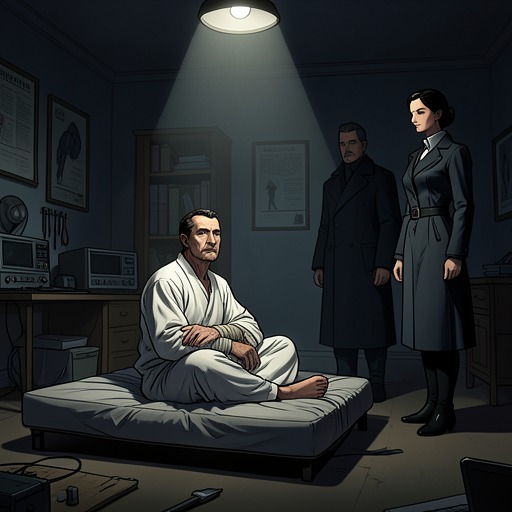
The Experiences of an Asylum Doctor
Kay ScarpettaThe Experiences of an Asylum Doctor is a book whose importance lies less in its physical presence than in the uncertainty surrounding it. Oscar Bane claims that he has hidden a compact disc inside the volume and gives Kay Scarpetta precise instructions for finding it. When Scarpetta searches for the book and discovers that it is not there, the object becomes a material measure of Oscar’s reliability: his account may encode a genuine warning, reflect confusion, or be an elaborate test. The title therefore links the novel’s investigation to the unstable boundary between psychiatric history, persecutory belief, and deliberate manipulation.
Bibliographic Identity
The title Oscar supplies is The Experiences of an Asylum Doctor, attributed by him to “Littleton Winslow” and described as a London publication from 1874. That attribution is false. Benton Wesley later identifies the real work as The Experiences of an Asylum Doctor by Montagu Lomax, published in 1921, roughly fifty years after Littleton Winslow, the son of Forbes Winslow, wrote his well-known Plea of Insanity. The correction is not a minor bibliographic detail: the book’s author, date, and historical placement have all been displaced inside Oscar’s account.
The novel’s opening also establishes the title’s conceptual charge by presenting the state of a person described as insane as “a walking, chaotic dream.” The phrase supplies a frame for the book’s recurring uncertainty. An asylum doctor’s observations belong to the history of institutional psychiatry, yet the title is repeatedly drawn into a present-day inquiry in which professional language, personal testimony, and imagined surveillance are difficult to separate.
Oscar’s Claimed Hiding Place
Oscar tells Scarpetta that the disc is concealed inside the book and provides an unusually exact location: the fourth shelf of the second bookcase to the left of the door in the study. He insists that Scarpetta is the only person who knows this. The specificity gives the claim the appearance of a verifiable message rather than a vague symptom. It also makes the book a transitional object between Oscar’s private fears and Scarpetta’s investigative authority: knowledge can be transferred only if she enters his space and performs the search he has prescribed.
Oscar connects the hidden disc to his belief that he is being electronically followed. He says that he had avoided telling Terri Bridges because he did not want to frighten her, but eventually disclosed the surveillance when she demanded to see his apartment and accused him of keeping secrets. The book consequently appears to hold his sole proof, while the secrecy surrounding it reinforces his conviction that hostile others are searching for the same evidence. His account presents the volume as both archive and defensive hiding place.
The Search and Its Reversal
When Scarpetta later visits Oscar’s study, The Experiences of an Asylum Doctor is nowhere to be found. She increasingly doubts him and wonders what kind of game he is playing. The absence is more damaging than a simple failure to locate a book, because Oscar had specified the shelf with such confidence. His instructions have turned the room into an experiment, and the missing object makes Scarpetta confront several incompatible possibilities: Oscar may have invented the title, misremembered the location, deliberately concealed the disc elsewhere, or constructed the riddle to test whether she cared enough to investigate.
The contradiction becomes concrete when Scarpetta and Benton inspect the relevant bookcase. Oscar’s designated fourth shelf contains archival boxes labeled “CIRCULARS,” not the promised volume. Benton concludes that the book does not exist under the author Oscar named. He suggests that Oscar distrusts everyone, genuinely believes he is watched, is confused, or is testing Scarpetta through a hidden message that requires her to solve a puzzle. The object thus changes status from alleged evidence to evidence about Oscar’s unstable narrative.
Connections to the Novel’s Information Systems
The book’s disappearance belongs to a wider pattern in which identities and messages are controlled through hidden or misleading forms. Terri Bridges uses the personal name “lunasee” for email, while Oscar’s account is associated with “carbane”; Lucy Farinelli explains that anonymous services can permit one person to become a crowd of aliases. Against this digital proliferation, the book represents an older form of concealment: a physical volume, a precise shelf, and a secret supposedly known by only two people.
That contrast gives the object particular force. Digital messages can be copied, impersonated, and distributed through multiple accounts; a book can be inspected directly, but only if it is actually present. The forged Scarpetta correspondence sent to Terri Bridges makes this tension explicit elsewhere in the investigation. A title associated with psychiatric testimony becomes caught in the same world of uncertain authorship and displaced identity as the emails, websites, and recordings.
Narrative Significance
The Experiences of an Asylum Doctor functions as a failed key. Oscar offers it as the route to hidden truth, but the search produces no disc and no stable confirmation of his story. Its historical correction by Benton and its physical absence from the shelf expose how easily expertise can be imitated: Oscar’s invented author and date sound plausible because they are embedded in a recognizable history of asylum writing and insanity defenses.
The object also concentrates the novel’s ethical tension around psychiatric labeling. Oscar is alternately treated as a frightened patient, a possible source of evidence, and a suspected criminal; his claims cannot be accepted simply because they are detailed, nor dismissed simply because they resemble persecutory belief. The nonexistent book leaves Scarpetta with neither a clean revelation nor a definitive diagnosis. Its deepest narrative function is therefore to make uncertainty tangible. A shelf that should contain proof instead contains labeled archival boxes, and that substitution turns the ordinary act of consulting a book into a confrontation with the limits of memory, authority, and belief.